
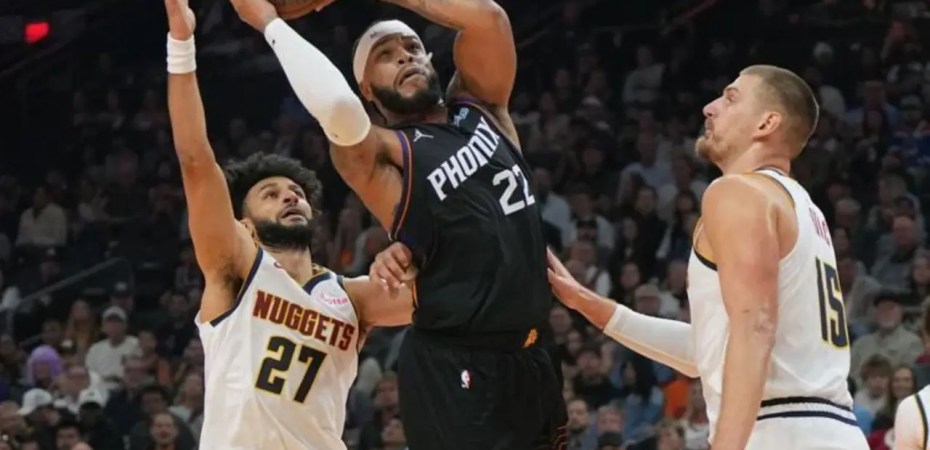
The Suns can score with the best of them. Unfortunately, stopping the best of them remains a problem.
PHOENIX, Arizona — October 31, 2026
If the Phoenix Suns want to be taken seriously as a Western Conference contender, somebody needs to remind them that basketball involves two ends of the floor.
Phoenix put up 120 points against the Denver Nuggets on Friday night and still walked away with a 127-120 loss. That’s what happens when your offense shows up ready to work but your defense appears to have called in sick.
Jamal Murray and Christian Braun combined for 70 points, Denver knocked down 20 three-pointers, and the Suns spent much of the evening trying to keep pace with a team that seemed perfectly comfortable turning the game into a shooting exhibition.
For Suns fans, it was another frustrating reminder that putting points on the board is only half the job. The other half involves making life difficult for the opposition, something Phoenix struggled to accomplish when it mattered most.
There were bright spots, including a strong performance from Miles Bridges, but the bigger picture remains concerning. Jalen Green is searching for his offensive rhythm, coach Jordan Ott is still figuring out his rotations, and the questions surrounding this roster aren’t going away just because the Suns managed to score 120 points.
The NBA Cup opener wasn’t a disaster. It was something potentially more frustrating: a reminder that the Suns have enough talent to make games interesting but still have plenty to prove before anyone should consider them a legitimate threat in the West.
And with Denver providing a firsthand demonstration of what a polished contender looks like, Phoenix has some homework to do.
THE NUGGETS EXPOSED THE BIGGEST PROBLEM
Let’s start with the obvious: You aren’t going to beat many good teams when you allow 127 points.
Especially when you’re trying to establish an identity built around effort, toughness, and defensive responsibility.
Denver shot 52.6% from three-point range, connecting on 20 shots from beyond the arc. Jamal Murray erupted for 39 points, while Christian Braun poured in 31. Nikola Jokic finished with 18 points and 10 assists, doing what Jokic does: making an incredibly difficult game look like a leisurely afternoon at the office.
Murray and Braun combined for 70 points.
SEVENTY.
That’s not a defensive breakdown. That’s a defensive group project in which half the class apparently forgot the assignment existed.
Phoenix actually started well, scoring 37 points in the opening quarter and carrying a 37-32 lead into the second. But Denver responded with a 39-point second quarter, seized control, and eventually built a 103-93 advantage heading into the fourth.
The Suns never managed to reclaim the lead in the final period.
And that’s where the concern begins.
Good teams can survive an opponent getting hot. Contenders can make adjustments, force difficult shots, and find ways to win even when the offense isn’t cooperating.
The Suns, at least on this night, couldn’t consistently do any of those things.
Their defense repeatedly struggled to keep up with Denver’s movement, leaving shooters with too much room and giving Murray the kind of opportunities that make opposing coaches age five years in a single possession.
Phoenix has offensive talent. Nobody is arguing otherwise.
But talent without defensive discipline is like buying a luxury sports car with no brakes. It looks impressive until you actually need it to stop.
HOW FAR AWAY ARE THE SUNS FROM CONTENDING IN THE WEST?
Let’s put the uncomfortable question on the table.
Can the Suns eventually become a serious Western Conference contender?
Possibly.
Are they one or two minor adjustments away?
Not based on what we’ve seen.
The Western Conference isn’t going to hand Phoenix a playoff spot out of sympathy. Teams such as Denver and Oklahoma City have established standards that extend beyond simply having a few recognizable names on the roster.
Contenders need consistent defense, dependable depth, reliable late-game execution, and multiple ways to win.
The Suns are still trying to figure out which version of themselves they want to be.
Against Denver, Phoenix scored 120 points and had three players reach at least 20. That’s encouraging. The offensive performance showed that this team can put pressure on an opponent and generate enough scoring to remain competitive.
But the defensive end remains a problem.
When a team gives up 127 points, it doesn’t matter how many attractive offensive possessions end with the crowd cheering. You’re going to spend the evening chasing the scoreboard.
And the margin for error gets even smaller in the playoffs, when opponents repeatedly attack the same weaknesses until somebody proves they can stop them.
The Suns need to demonstrate that they can defend for 48 minutes, not just in scattered stretches when the energy happens to be there.
They also need a clearer hierarchy offensively, more consistency from their perimeter players, and rotations that allow the team to build chemistry instead of constantly feeling like a basketball experiment.
Until those things happen, talk of a championship should come with a warning label.
The Suns aren’t hopeless, but they have a considerable amount of work to do before they belong in the same conversation as the West’s genuine title contenders.
JALEN GREEN: IS THE TRADE TALK GETTING IN HIS HEAD?
Jalen Green’s performance against Denver was difficult to ignore for all the wrong reasons.
Green finished with just two points on 1-of-6 shooting in 25 minutes. He added two rebounds and two assists, but never established much of an offensive rhythm.
For a player whose athleticism and scoring ability are supposed to provide a major boost, that’s not nearly enough production.
Of course, one bad game doesn’t tell the entire story.
Green is still adjusting to his role, figuring out where he fits alongside Devin Booker, and trying to turn his natural scoring instincts into a more complete style of basketball.
That’s a process. But it’s a process the Suns need to start seeing results from.
Then there’s the elephant in the locker room: trade speculation.
When a player hears his name mentioned in trade conversations, it’s reasonable to wonder whether that uncertainty affects his confidence. Even talented players can start pressing when they feel they have to prove their value on every possession.
Instead of allowing the game to come to him, Green might begin searching for the big play. A missed shot becomes frustrating. A turnover becomes a bigger deal. Suddenly, a player who normally attacks without hesitation starts thinking a little too much.
Could trade rumors be contributing to Green’s struggles?
It’s possible, but there’s no way to establish that from one performance. His shooting problems could just as easily reflect the normal adjustment period that comes with a new role, inconsistent rhythm, and the challenge of finding his place in a crowded offense.
Still, Phoenix needs to figure out what it wants from him.
If Green is part of the long-term plan, the Suns must give him a defined role, meaningful opportunities, and the coaching necessary to develop his decision-making.
If the organization doesn’t believe he’s the right fit, then it needs to make a decision instead of allowing uncertainty to hang over the situation.
What Phoenix cannot afford is a talented young player spending his season looking over his shoulder while the team struggles to establish an identity.
Green has too much ability to disappear offensively.
But ability isn’t the same thing as production, and the Suns need to see more of the latter.
COACH JORDAN OTT’S ROTATIONS: EXPERIMENTATION OR CONFUSION?
Head coach Jordan Ott has a difficult job.
He’s trying to establish a system, figure out which players complement one another, manage minutes, and find combinations that can compete against the best teams in the league.
Nobody should expect every rotation decision to be perfect this early in the season.
But patience doesn’t mean every decision gets a free pass.
The Suns need consistency in their rotations, particularly when they’re trying to build chemistry between their primary scorers and supporting cast.
Against Denver, Collin Gillespie provided a valuable spark off the bench, finishing with 16 points and 10 assists. His ability to organize the offense and get teammates involved offered a reminder that the Suns need players who can create opportunities rather than simply wait for Booker to manufacture them.
Oso Ighodaro also brought useful energy and playmaking, while the team’s better offensive stretches came when the ball and players moved with purpose.
Those are clues for Ott.
Phoenix looks more dangerous when its offense doesn’t become a predictable cycle of one player holding the ball, another player standing in the corner, and everybody else waiting for something to happen.
The challenge is turning those encouraging stretches into a consistent approach.
Ott also has to decide how much patience to show Green, how to maximize Gillespie’s playmaking, and which combinations can defend without sacrificing too much offense.
And there’s a broader question: How much experimentation can this team afford when its defensive problems are already costing it games?
Coaches need flexibility, but players also need to know what their responsibilities are and when they’re going to be on the floor.
Constantly searching for the perfect lineup can become counterproductive if the team never gives promising combinations enough time to develop.
Ott deserves the opportunity to build something.
But Suns fans have heard plenty about potential, development, and finding the right formula. Eventually, the experiments have to produce wins.
Preferably before everybody starts looking at the standings and wondering whether the season has taken a wrong turn.
MILES BRIDGES GIVES FANS SOMETHING TO CHEER ABOUT
Not everything about Friday night belonged in the basketball equivalent of a complaint department.
Miles Bridges delivered one of the game’s biggest bright spots, finishing with 24 points and 10 rebounds.
He shot 10-of-19 from the field and provided the kind of aggressive offensive production Phoenix needed to stay within striking distance.
Bridges attacked the basket, converted opportunities, and gave the Suns another player capable of making the defense pay.
His performance mattered because Phoenix needs scoring contributions that don’t depend entirely on Booker having a spectacular night.
Booker finished with 20 points, but he didn’t consistently find the offensive rhythm necessary to take over the game. When your primary scorer isn’t dominating, you need somebody else to step forward.
Bridges did exactly that.
His 24 points and 10 rebounds were an encouraging reminder of what the Suns can look like when another player supplies reliable production.
And the rebounding matters, too. Phoenix needs players willing to do the dirty work, compete physically, and contribute when the shots aren’t falling.
Bridges isn’t going to solve every problem on this roster, and one good performance doesn’t automatically transform Phoenix into a playoff powerhouse.
But his night was something Suns fans can appreciate without having to squint at the box score.
Sometimes, a bright spot is just a bright spot.
In Phoenix, we’ll take it.
DEVIN BOOKER CAN’T DO EVERYTHING
Booker scored 20 points on his 30th birthday, but the evening didn’t exactly end with a celebratory cake and a victory.
He shot 7-of-19 from the field and recorded five assists, four turnovers, and two steals.
Those numbers tell a familiar story: Booker can still provide the scoring punch Phoenix needs, but the Suns have to make his job easier.
He shouldn’t have to be the primary scorer, the offensive organizer, the late-game problem solver, and the player expected to rescue the team whenever the defense springs another leak.
That’s too much responsibility for one player, regardless of how talented he is.
Phoenix needs other players to create offense, make decisions, and take pressure off Booker.
It also needs to use him intelligently. More movement away from the ball, better screening, and quicker decisions can help prevent the offense from becoming predictable.
Booker remains a central part of the team’s future, but the Suns need a collective plan that doesn’t rely on him producing a heroic performance every night.
Superstars can carry teams through difficult stretches.
They can’t permanently cover up every roster flaw.
THE NBA CUP IS HERE. NOW WHAT?
The NBA Cup gives the Suns another opportunity to compete for something meaningful early in the season.
But let’s be honest: Phoenix has bigger concerns than a tournament trophy.
The Cup can provide motivation, create urgency, and give the team a chance to build momentum. Winning these games would certainly help the atmosphere around the franchise.
But the tournament doesn’t change the basic requirements for success.
The Suns still have to defend, execute, and prove they can beat quality opponents when the pressure rises.
Friday’s loss to Denver offered a little encouragement on offense and another uncomfortable reminder that the defensive end needs serious attention.
The encouraging part is that Phoenix scored 120 points and remained competitive deep into the game.
The discouraging part is that Denver scored 127 and left town with the victory.
Both things can be true.
The Suns don’t need to panic because of one loss, but they also shouldn’t mistake a respectable offensive performance for evidence that the larger problems have disappeared.
THE BOTTOM LINE: SUNS FANS DESERVE MORE THAN POTENTIAL
There were positives against Denver.
Bridges was productive. Gillespie helped organize the offense. Booker reached 20 points. And the Suns showed stretches of energy and ball movement that could provide a foundation for improvement.
But the final score was 127-120, and the same questions remain.
Can this team defend consistently?
Can Green become a reliable offensive contributor?
Can Ott settle on rotations that maximize the roster’s strengths?
Can Phoenix develop enough depth and chemistry to compete with the West’s best teams?
Those aren’t minor details. They’re the difference between a team that occasionally makes noise and one that genuinely threatens to win something.
The Suns have talent, but talent is only the starting point. It takes discipline, continuity, smart decisions, and a willingness to address weaknesses before they become season-long problems.
For now, Phoenix looks like a team capable of being competitive on a given night but not yet equipped to sustain that level against the conference’s elite.
And that’s the frustrating part for Suns fans.
Nobody expects perfection in October. But after watching this franchise chase championship expectations, fans have every right to want evidence that the organization is moving in the right direction.
Friday night provided a few reasons for optimism.
It also provided 127 reasons to worry about the defense.
The Suns don’t have to become a championship team overnight. They do, however, have to start looking like a team with a believable path toward contention.
Until then, Phoenix fans should enjoy the good stretches, celebrate the individual performances, and keep their expectations somewhere between hopeful and heavily medicated.
Because in the Western Conference, a few encouraging possessions won’t get you very far.
The Suns have shown they can score with good teams. Now they have to prove they can stop them.

