
By KSRN AZ Sports Staff
There are bad football teams, there are poorly run football teams, and then there are the Arizona Cardinals — a franchise that has turned disappointing its own fans into something resembling an annual tradition.
Seven games into the 2026 season, the Cardinals are 2-5. They are scoring just 20.3 points per game while surrendering an absolutely disgusting 29.7. Their defense ranks dead last in the NFL in points allowed, and their overall point differential sits at minus-66.
Read those numbers again.
Dead last in points allowed. Two wins. Five losses. A minus-66 point differential.
Apparently, the Cardinals’ offseason strategy was to cross their fingers, hope a few players developed, and pray opposing offenses would suddenly forget how to play football.
Unfortunately for Arizona, NFL offenses have not received the memo.
And now the fans are left watching another season slip away while wondering whether anybody running this organization understands what it takes to build a legitimate football team.
Spoiler alert: The scoreboard suggests otherwise.
THE DEFENSE: AN OFFSEASON MASTERPIECE OF INCOMPETENCE
Let’s start with the side of the football that should have received the organization’s undivided attention.
The defense.
Last season, Arizona finished 3-14. During the final nine games of that miserable campaign, the Cardinals surrendered 317 points. That was the kind of defensive collapse that should have triggered a serious organizational reckoning.
Instead, the franchise apparently decided that a few adjustments and some internal improvement would be sufficient.
The 2026 offseason offered Arizona an opportunity to address the problem through free agency and the draft. General manager Monti Ossenfort could have prioritized proven defensive talent, invested premium draft capital in the front seven, and given the coaching staff better personnel to work with.
Instead, the Cardinals passed on using their first three draft picks on defensive players and failed to make a major financial commitment to a defensive free agent.
The message was difficult to miss: Arizona was willing to gamble that the players already on the roster would suddenly become something they had not consistently demonstrated they could be.
That gamble is going about as well as a screen door on a submarine.
Through seven games, the Cardinals have surrendered 208 points, an average of 29.7 per contest. They are allowing more than 4.5 touchdowns per game when field goals are included in the total. Opponents have scored 17 passing touchdowns against them while completing 69.6% of their red-zone opportunities.
That last number is particularly ugly.
When opposing offenses reach the red zone, they are scoring touchdowns nearly seven times out of ten.
That’s not a defense imposing its will. That’s an invitation to the end zone.
Arizona’s opponents have also accumulated 2,480 total yards through seven games, averaging approximately 354 yards per contest. The defense has generated just six takeaways as a team, including three interceptions.
The Cardinals are not creating enough turnovers to compensate for their inability to keep opponents off the scoreboard. They aren’t consistently controlling games, and they aren’t giving their offense much room for error.
A defense doesn’t have to be perfect. It does, however, have to be functional.
This one has been anything but.
WHAT EXACTLY WAS THE PLAN?
This is where the front office deserves serious criticism.
Nobody expected Arizona to transform into the 2000 Baltimore Ravens overnight. Rebuilding takes time, and salary-cap management requires difficult decisions.
But there is a substantial difference between rebuilding intelligently and expecting improvement without making a serious investment in the areas that need it most.
After a 3-14 season, the Cardinals needed defensive help. That wasn’t a complicated mystery requiring an expensive consulting firm to solve.
They needed more disruptive players up front. They needed a defense capable of getting off the field on third down. They needed better results against opposing passing attacks. And they needed enough depth to survive injuries without the entire unit collapsing.
Instead, the organization leaned heavily on player development and the hope that existing personnel would improve.
Hope is a wonderful thing.
Hope is not a pass rusher.
Hope doesn’t tackle the quarterback.
Hope doesn’t cover a receiver streaking down the sideline.
And hope certainly doesn’t prevent an opponent from hanging 30 points on your team.
The results have exposed the risk of that approach. Arizona’s defense ranks 32nd in points allowed, and opponents have scored 208 points in seven games.
The front office cannot reasonably expect fans to accept the same defensive problems year after year while treating the lack of major reinforcements as some kind of sophisticated long-term strategy.
At some point, potential must become production.
At some point, the excuses must stop.
And at some point, somebody in the Cardinals’ building must acknowledge that the roster simply hasn’t been good enough.
MICHAEL BIDWILL: THE BUCK STOPS AT THE TOP
No discussion of the Cardinals’ recurring problems is complete without addressing ownership.
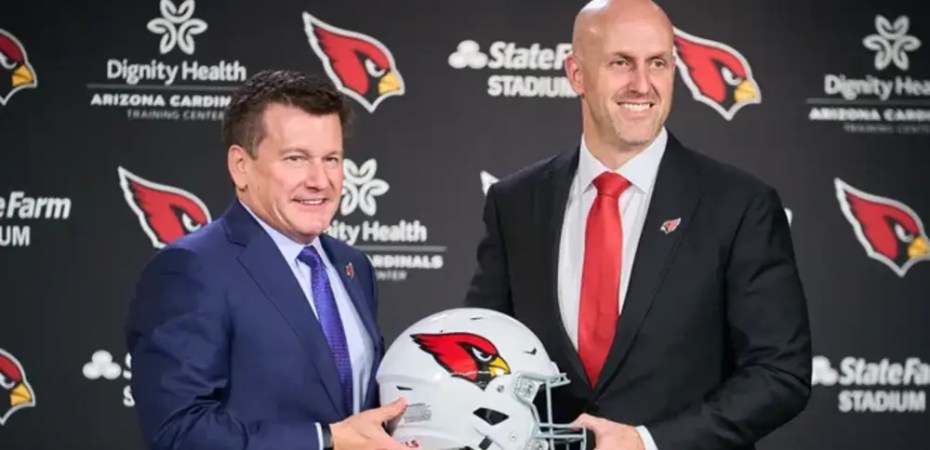
Michael Bidwill owns the franchise. He is ultimately responsible for the people making the major football decisions, the organizational culture those people create, and the standard of performance the organization expects.
That doesn’t mean Bidwill personally calls defensive plays or decides which receiver runs a particular route.
It means he is responsible for hiring people who can build a winner and holding them accountable when they fail.
And that’s where the frustration becomes difficult to ignore.
The Cardinals have spent years asking their fans for patience. There have been coaching changes, roster changes, quarterback changes, new plans, fresh starts, and plenty of explanations for why the next chapter might finally be different.
Yet the fundamental question remains: When will this franchise consistently deliver a team worthy of its fans’ investment?
Fans spend money on tickets, merchandise, parking, concessions, and subscriptions to follow their team. They devote their Sundays to a franchise that has repeatedly struggled to establish itself as a consistent contender.
They deserve more than another round of promises.
They deserve competent roster construction, a coherent football philosophy, and evidence that winning is the actual objective rather than a pleasant side effect.
The 2026 season is already providing reasons for concern. Arizona entered the year after a 3-14 finish, and the team is now 2-5. The defense remains the league’s worst by points allowed despite an offseason in which defensive investment was conspicuously limited.
Those are football decisions, not acts of fate.
Ownership cannot control every injury, every bad bounce, or every questionable call. But it can establish a standard that makes sustained mediocrity unacceptable.
The most damning criticism of Bidwill isn’t that every decision has been wrong. It’s that Cardinals fans have too often been left wondering whether the organization has the urgency, ambition, and football leadership necessary to compete consistently.
If the franchise believes its current approach is working, the standings and statistics are making a rather persuasive argument to the contrary.
And if the approach isn’t working, why should fans believe the same leadership will suddenly get everything right without meaningful changes?
That’s a question Bidwill and the football operation need to answer with results, not public-relations talking points.
THE QUARTERBACK SITUATION: A TEMPORARY SOLUTION IS NOT A FRANCHISE PLAN
Then there’s the quarterback position.
Arizona entered the season with uncertainty surrounding Kyler Murray’s place in the team’s long-term plans. Jacoby Brissett has been the starting quarterback through seven games, leaving the organization with another season in which the most important position on the field is a major talking point.
Brissett’s individual numbers deserve a fair assessment.
Through seven games, he has completed 183 of 282 passes for 1,600 yards, 10 touchdowns, and six interceptions. That’s a completion rate of 64.9%, with an average of 228.6 passing yards per game.
His passer rating is 82.8.
Those numbers aren’t catastrophic. Brissett has shown that he can distribute the football, move the offense at times, and give Arizona competent stretches of quarterback play.
But there’s a difference between being a capable veteran and having a settled, long-term answer at quarterback.
Brissett has averaged 5.7 yards per pass attempt. That is not the kind of figure that suggests the Cardinals are consistently stretching defenses or generating explosive production through the passing game.
Ten touchdown passes against six interceptions is a respectable starting point, but it hardly eliminates questions about the ceiling of the offense.
And the team has won only two of its seven games.
To be clear, the quarterback cannot be blamed for everything. Asking a quarterback to rescue a team that gives up nearly 30 points per game is a ridiculous way to evaluate football. Brissett cannot play defense, and he cannot single-handedly correct the roster-building decisions made over several seasons.
Nevertheless, the quarterback situation remains an organizational concern.
What is the plan?
Is Murray still viewed as the long-term answer? Is Brissett simply keeping the seat warm? Is the organization preparing to pursue another quarterback? And how does any potential decision fit into the larger rebuilding process?
The Cardinals need a clear answer to those questions.
Instead, the quarterback position remains another source of uncertainty for a franchise that already has enough problems.
The worst thing Arizona could do is make a major quarterback decision simply to distract fans from its defensive failures.
A new quarterback might generate excitement. A high-profile acquisition might sell jerseys. A draft pick might give fans another reason to tune in.
But none of that matters if the organization continues to build a roster with glaring holes on the other side of the ball.
The Cardinals don’t need another shiny object.
They need a coherent plan.
THE OFFENSE ISN’T EXACTLY SAVING THE DAY
While the defense deserves the harshest criticism, the offense shouldn’t escape scrutiny.
Arizona has scored 142 points through seven games, averaging 20.3 per contest. That ranks 26th in the league.
The team has accumulated 2,197 total yards, or approximately 314 yards per game.
Those aren’t numbers associated with a dangerous, consistent offensive attack.
There are bright spots. Tight end Trey McBride has been a productive weapon, recording 59 receptions for 472 yards and four touchdowns. His 59 catches lead the NFL through the seven-game sample, and he has given the offense a reliable option when it needs a completion.
But McBride’s production also raises a larger question: Why does the offense so often feel like it needs individual players to compensate for problems elsewhere?
Arizona has weapons. It has players capable of making plays. Yet the offense has not consistently translated those individual contributions into enough points to win games.
The Cardinals have scored 10 passing touchdowns and three rushing touchdowns as a team.
Meanwhile, their opponents have scored 17 passing touchdowns and eight rushing touchdowns.
That’s the difference between an offense that is struggling to generate enough production and a defense that is struggling to stop virtually anything.
The Cardinals need better offensive consistency, more explosive plays, and a more convincing plan at quarterback.
But let’s not pretend the offense is the biggest fire burning in Arizona.
The defense is currently holding the gasoline.
THE BIGGER PROBLEM: THIS FRANCHISE HAS RUN OUT OF EXCUSES
Every struggling team has explanations.
Injuries happen. Young players need time. New coaching staffs require adjustment periods. Salary-cap restrictions create difficult choices. Draft picks don’t always develop as expected.
All of those things are true.
They are also true for every other team in the NFL.
The difference is that successful organizations find ways to overcome those obstacles. They identify weaknesses, invest in solutions, develop their talent, and make difficult decisions when the existing approach fails.
The Cardinals have entered 2026 coming off a 3-14 season, and through seven games they are 2-5. Their defense ranks last in the league in points allowed, while the offense sits 26th in scoring.
The team is averaging 20.3 points per game and allowing 29.7.
That is a scoring deficit of 9.4 points per contest.
Over seven games, the Cardinals have been outscored by 66 points.
Those numbers are not a matter of opinion. They are the scoreboard’s verdict on the product Arizona has put on the field.
And the offseason decisions deserve to be examined in that context.
When a team finishes 3-14, the expectation should be an aggressive effort to address its weaknesses. Instead, Arizona made a calculated bet that its defense could improve without significant new investment.
So far, that bet looks awful.
The organization can talk about development, patience, and the long-term vision all it wants. But the longer the results remain this poor, the less convincing those explanations become.
Fans aren’t demanding perfection.
They’re demanding evidence of progress.
Right now, that evidence is awfully difficult to find.
WHAT NEEDS TO HAPPEN NEXT?
First, the Cardinals must stop treating defensive improvement as something that will magically happen.
The front office needs to identify the specific personnel weaknesses responsible for the unit’s failures and pursue legitimate upgrades. That means evaluating defensive-line talent, pass-rush production, linebacker play, and coverage performance rather than assuming internal development will solve everything.
Second, the organization must establish a definitive quarterback plan.
Whether the answer is Murray, Brissett, or a future acquisition, the decision needs to fit a larger roster-building strategy. The Cardinals cannot afford to keep drifting at the position while other parts of the roster deteriorate.
Third, the coaching staff must be evaluated honestly.
Players deserve accountability, but so do coaches. If a unit repeatedly fails to execute, the organization must determine whether the problem is personnel, scheme, preparation, or some combination of all three.
Finally, Bidwill must demand measurable improvement from the people responsible for running the football operation.
Not another slogan.
Not another promise.
Not another explanation about how things will eventually come together.
Results.
That’s the entire point of professional football.
FINAL VERDICT: SAME OLD CARDINALS?
The Arizona Cardinals are 2-5. They rank 32nd in points allowed, 26th in points scored, and have been outscored by 66 points through seven games.
Their quarterback situation remains unsettled, and their offseason approach to fixing the defense has produced precious little evidence of a turnaround.
Those numbers tell a story of a team that has a long way to go.
They also raise serious questions about the judgment of the people responsible for building the roster.
Arizona’s fans deserve a team with a direction, an identity, and a legitimate plan to compete. They deserve a front office that treats a 3-14 season as a crisis demanding decisive action, not an inconvenience that can be addressed with a few modest adjustments.
Most of all, they deserve an organization that understands the difference between asking for patience and earning it.
Right now, the Cardinals haven’t earned much.
The defense is giving up nearly 30 points a game. The offense isn’t scoring enough to compensate. The quarterback situation is still a question mark. And the franchise’s leadership has yet to provide convincing evidence that the current approach is going to produce a winner.
This isn’t about demanding a Super Bowl every year.
It’s about demanding competence.
It’s about expecting a professional football franchise to recognize its weaknesses and do something meaningful to correct them.
And it’s about refusing to accept the idea that Cardinals fans should simply smile, buy another ticket, and hope next season will somehow be different.
Michael Bidwill and the Cardinals’ football leadership need to understand something: The fans aren’t obligated to remain patient forever just because the franchise keeps asking them to be.
Seven games into the 2026 season, Arizona has given its supporters plenty of reasons to be angry and very few reasons to be optimistic.
If this is the plan, the plan stinks.
And unless something changes, the Cardinals are on course to deliver another miserable season to a fan base that has already endured far too many of them.
Same old questions. Same old frustration. Same old Cardinals.
At some point, enough has to be enough.

